Christian, in flight at the District Finals . . .

It took me a while, but I eventually noticed a pattern: It was the last of Christian’s track meets and I had just finished watching the closing races of the season. Long distance races have always intrigued me because they are lengthy enough for a narrative to develop, for a back and forth, for a test of stamina, for the dramatic come back win. But it wasn’t the dynamics of victory that caught my attention on Thursday. It was the reaction of the crowd to the various participants in the race. Predictably, the first few runners got the cheers of victory. But so did the very last runners, especially if they were way behind and struggling. We feel for the underdog, the determined “loser.” But what about those in between runners? What did they get? Wild cheers from their parents, perhaps (or sometimes suppressed disappointment). But from the crowd at large? Mild interest, half-hearted applause, if that. But mostly, they were invisible, extras to frame the exploits of the first runners and the determination of the last.

Invisibility has been on my mind since Michelle Obama mentioned the idea in her speech earlier this week at Tuskegee University. She spoke of the challenges of the African American experience this way:

“So there will be times, just like for those Airmen, when you feel like folks look right past you, or they see just a fraction of who you really are . . . the realization that no matter how far you rise in life, how hard you work to be a good person, a good parent, a good citizen — for some folks, it will never be enough.  And all of that is going to be a heavy burden to carry.  It can feel isolating.  It can make you feel like your life somehow doesn’t matter — that you’re like the invisible man that Tuskegee grad Ralph Ellison wrote about all those years ago.”

michelle-obama-tuskegee

Some of the kids at the middle school track meet worked really hard, gave it everything and still did not end up receiving honor for their work. They were invisible.

That made me consider my own experience with invisibility.

The truth is I don’t have a harrowing story to tell. I cannot say I have felt invisible on account of my race for example . . . well, that’s not quite true. Quick context: I grew up in Kenya, biracial with a Scottish mother and a Kenyan father. In Kenya, there is a defined racial category for mixed people. We are called “point-fives”; you cannot deny the mathematical accuracy of that term! Connotation? Not derogatory at all. If anything, the term is used positively. At least, that was how I experienced the word growing up. So, like many biracial African immigrants, I came to America, and became “black” for the first time (One of my favorite comedians, Trevor Noah, has a great bit on the same experience https://www.youtube.com/watch?v=QDXWUBIUi88!). The transition to “black” took some adjustment, but was ultimately fine, except in one area, casting.

I came to America to pursue a graduate degree in Theatre (Acting) and began to notice a trend. Directors would come up to me and say “I think you’d be great for this role” and I slowly began to notice that all the roles I’d be “great for” were black roles, that is explicitly written as black characters. Many of these roles were in fact good, but in those same plays I saw many other attractive roles that were not necessarily written as black characters. I was used to being selected for roles based on the depth and layers of the character, but now part of me was invisible. To some, I was black first, an actor second (quite the adjustment after being in an all Kenyan cast of Fiddler on the Roof many years ago. Yes, you read that right; 40 Kenyans playing Russian Jews without batting an eyelid!). That said, there have been many notable exceptions: I was cast as Jack in The Importance of Being Earnest and Pooh Bah in The Mikado by directors who recognized, but did not define, my acting by my color. I respected that.

But how did the limited view that some other directors took feel? It felt restrictive of course, but perhaps also put me in touch with certain parts of the minority experience in America in a more tangible way.

I must emphasize, though, that these challenges in no way compare to the very real, difficult and often daily experience of many in this country who are just not seen, either on account of their race, class, financial status, or position in all the races we run. But, I at least caught a glimpse of Ralph Ellison’s predicament in The Invisible Man:

“When they approach me they see only my surroundings, themselves or figments of their imagination, indeed, everything and anything except me.”

In medicine, there is an irony that it is possible to look at patients very closely, yet somehow manage not to see them. We pore over chest x-rays, dissect MRIs, scrutinize pathology slides, diligently save the finest image slices of their brains in a navigation program, yet somehow miss who they are.

So how then do we see the invisible?

There is a difference between the invisibility of an object and that of a person. A truly invisible object has some intrinsic quality that makes its presence unapparent. But an invisible person is not intrinsically invisible. That invisibility is conferred. That is what is so disheartening, that we as humans would ever choose to not see someone else. But perhaps, therein lies also the possibility for change. If we can confer invisibility, we can confer visibility. Each day can be an exercise in noticing the “middle runners.” Who is invisible to you? Who can you choose to see?
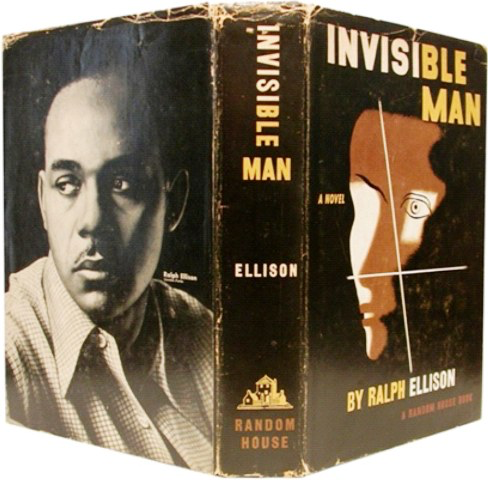
RalphEllison

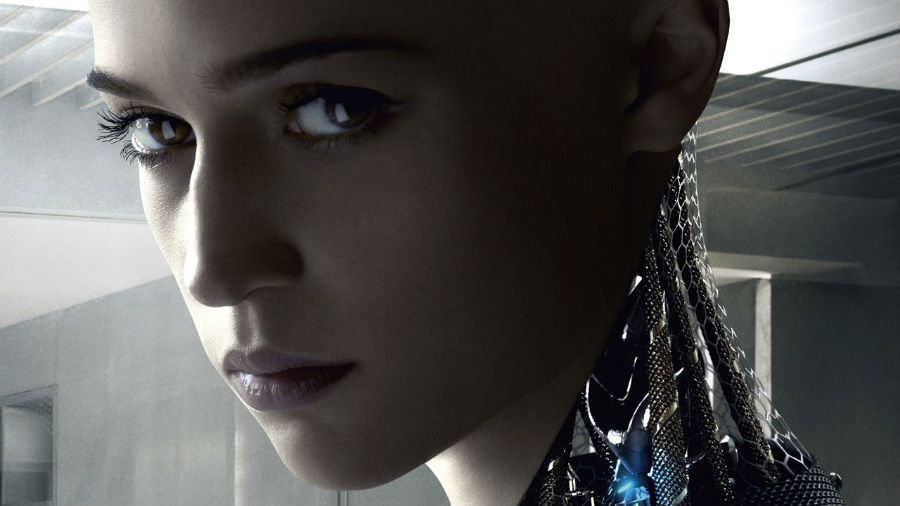
Ex Machina

Ex Machina (2015)

They say things happen in threes.

One, I watch a movie, Ex Machina, which poses provocative questions about how real an artificially intelligent human can be.

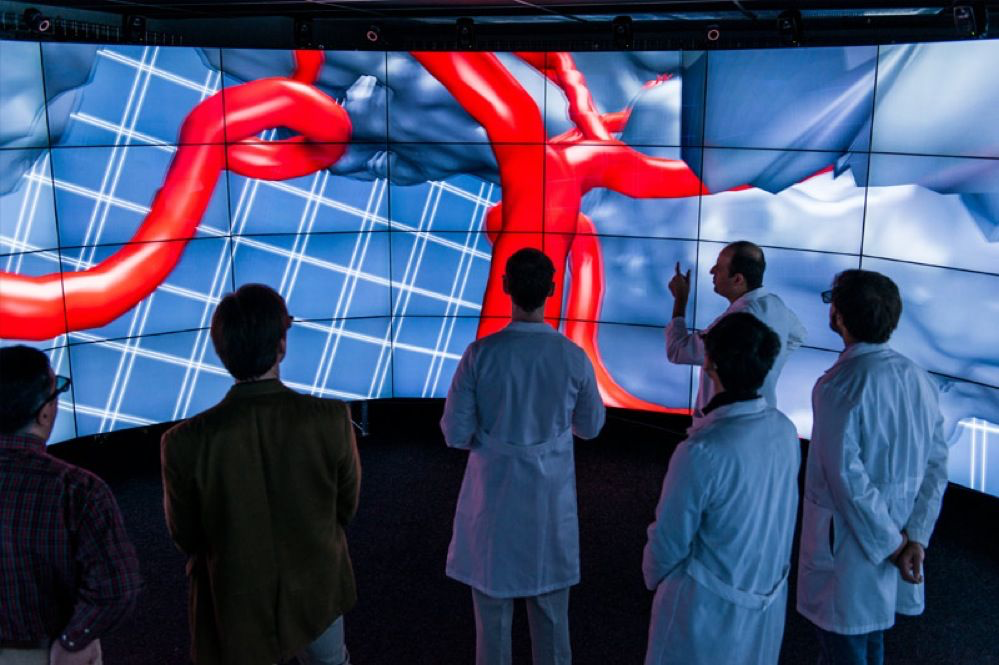
Two, I am in the middle of Neurosurgery research and come across some of the latest applications of Virtual Reality to navigate around the brain as if you were inside it.

Three, I get an email from my medical school about a new project in which students can practice difficult conversations with patients by speaking with virtual humans.

I like toys, but I do not consider myself a techie. Yet, I find myself fascinated by the concept of Virtual Reality. Why?

Then it hits me. I am trained in Theatre. Theatre is, by definition, Virtual Reality! You create a 3-D space with objects that look real but aren’t (as any actor who has had to eat cold mashed potatoes as if it were delicious ice-cream will tell you!). You surround yourself with people who are supposed to be real people  with whom you have real relationships. But of course, the whole thing is made up. The curtain will come down (the “console” will switch off). And just like that, Richard III becomes your cast mate and you go get a drink, no longer having to worry about being impaled on a sword (unless you gave a terrible performance . . .). And yet, your imaginary creation sent a room full of people home feeling new emotions and thinking new thoughts.

And so, the question becomes if the “Virtual Reality” of Theatre can provoke an emotional response, could the computerized Virtual Reality do the same, and perhaps even trigger the crucial emotion of empathy? That question must have occurred to journalist Nony Lapena when she teamed up with technologist Palmer Luckey to create a virtual world to portray the devastating reality of war-torn Syria http://techcrunch.com/2015/02/01/what-it-feels-like/

Her work was presented at this year’s Sundance Festival. So why does Ms. Lapena do it?

“Syria is so far away from most Americans. How do you attract a younger audience who might not pick up the newspaper to think about these important issues? That’s the point of all good journalism.”

Project Syria

All of which takes us back to the medical school project. Can interacting with virtual humans really help me prepare for such conversations with real patients? That depends, I imagine, on how “real” they are. And how do you know that? At what point does a computerized human cross that threshold? The movie Ex Machina proposed The Turing Test in which a human interacts with a machine that she is blinded to. If the responses of the machine convince the interrogator that she is speaking to a human, the machine has passed the test. In developing this test, Alan Turing raised an interesting point. The question, he said, is not can a machine think, but can it imitate human thought?

I have heard this line of reasoning used before in terms of empathy. Do we need to feel empathy to show it? Or is empathy a skill, a craft that should be learned like any other part of the physician’s arsenal?

The neurosurgeon uses Virtual Reality to master the architecture of the brain, through relentless repetition and adjustment. Can empathy be achieved in the same way? Is it trainable?

Virtual Reality Surgery

Virtual Reality Surgery

And, ultimately, when the headset is removed, the electronics shut down, and I am sitting in front of a patient with all our histories, biases and experiences present, but invisible and we begin to talk, into what reality have we just entered?

Have an existential weekend!

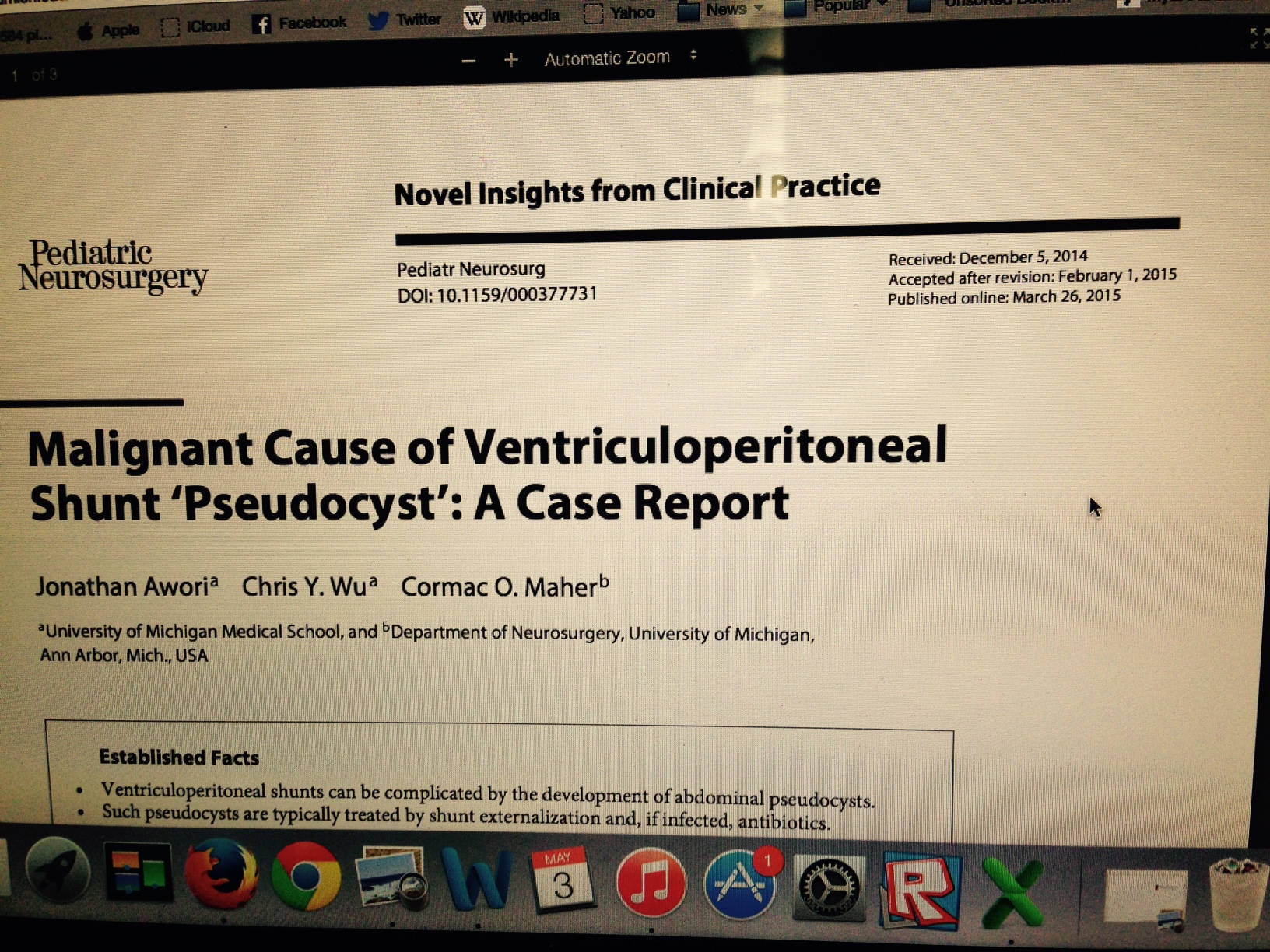
Research Graphic

Quite unexpectedly, I have found myself taking a detour in my medical school journey. I will spend the next 2 years on a research leave of absence from medical school in which I will pursue a Masters in Clinical Research through the School of Public Health at the University of Michigan. I will then apply to residency in September 2016 and graduate in May 2017 to start residency in July 2017.

This Masters program, though, does not begin till September this year so I get to spend the summer with my whole family in Elk Grove (Sacramento) California. Anne just joined us from LA after completing a grueling first year in her Masters of Architecture program. I’m extremely proud of her.

I plan to take advantage of this summer to dig into Neurosurgery research. I am currently working on two projects: the first project is based on my research at Kijabe Hospital earlier this year, focusing on hidden costs to families in obtaining pediatric neurosurgical care in Kenya. The second project looks at a rare but significant complication of the treatment for SubArachnoid Hemorrhage (bleeding in the brain). This complication is called PRES (Posterior Reversible Encephalopathy Syndrome) and occurs when fluid and proteins escape the blood vessels and thus cross the blood brain barrier. This is apparently more likely to occur when the blood pressure is high, which is exactly what we want to raise to treat vasospasm (narrowing) of vessels following sub-arachnoid hemorrhage. So this represents a classic medical dilemma: What do you do when the treatment for one condition precipitates another?

I am enjoying this research, but I must admit I was initially wary about engaging in such a dedicated period of study. I was concerned about long hours in front of a computer screen and limited human contact. Unlike some of my other endeavors like medical globe-trotting and teaching Improv, protracted research seemed decidedly unsexy! I miss the clinical scene, but research is striking unexpected chords within me. There is something captivating about seeking unearthed knowledge and adding something new to the literature. Research allows you to share knowledge that can potentially affect the care of millions of patients. Research appeals to the big picture, the “why” of medicine and that is compelling. You see, I don’t think doctors should be let off the hook of being challenged to think big. Yes, medicine is noble and takes a lot of work and that should be acknowledged. But becoming a doctor is only the beginning. Are we thinking big enough? Empathetically enough? Or is it simply easier to hide self-interest under a white coat?

This surprising level of engagement in research led me to wonder what other things I underplay that may, in fact, be meaningful. We decide early on that certain pursuits are not for us and justify that saying “That’s not me” or “That doesn’t fit my personality” but this rationale presumes that we have a complete and accurate perception of who we are. It also ignores the fascinating contradictions that make us human. What happens, instead, if you only decide who you are after you pursue certain paths instead of pre-judging the path based on a potentially imperfect perception of yourself?

You might just surprise yourself . . .

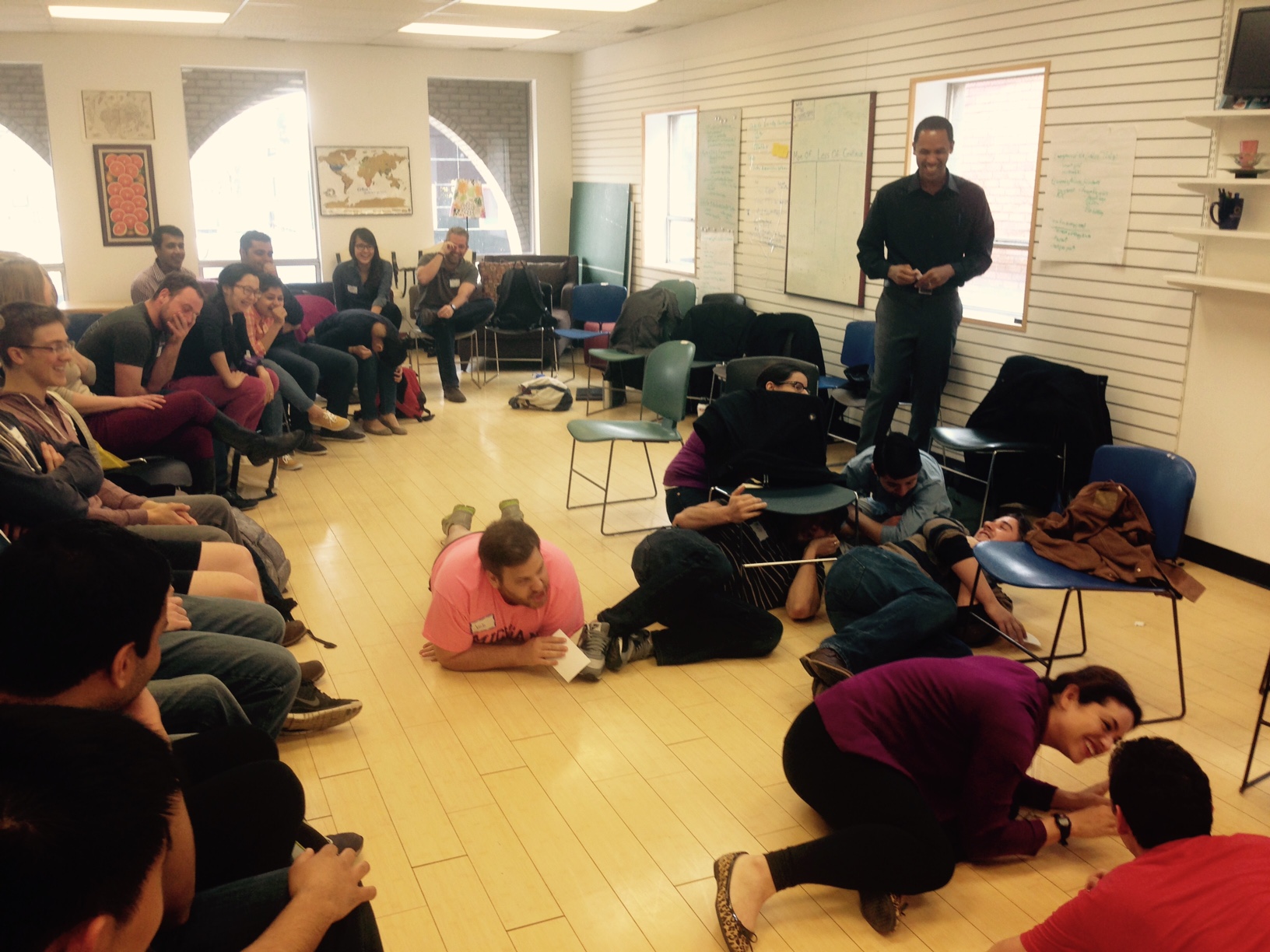
Improv 2

Improv! The word quickly connotes quick-witted actors leaping around a stage creating bizarre story lines. Or perhaps the word conjurs up Saturday Night Live or the classic Improv show, Whose Line is It Anyway? So, how did I find myself, in my fourth year of medical school, teaching Improv to MBA students?

Last year, I took part in a global social entrepreneurship student competition called the HULT prize. One my team members would later remember my background as a Theatre professor and actor and whispered that in the ear of the Design and Business Club at the University of Michigan Ross School of Business. They happen to have started a program of events known as StoryLab to expose business students to the nature of the story as a potential tool in business. They asked me if I would consider leading a workshop. As they had already learned about elements such as story structure, body language and physical presence, I thought the next step could be learning how to create a story from scratch, that is Improv!

And so, on April 3rd, I met with a group of MBA students and we did Improv. I wanted this session to be fun, which Improv always is, but also relevant. I could have the students prance about the room like gazelles and that would be entertaining, but why would that ultimately matter to a group of business students? So the first thing I did was challenge the students to get beyond thinking of Improv as the purview of trained actors. I pointed them to the work of Theatre practitioner Keith Johnstone who notes that we are all born natural improvisers. Children create narratives effortlessly and transform everyday objects into dynamic magical things every day. As we speak, my son Cameron is making a cardboard box into full body armor and a helmet for space travel. Johnstone argues that this natural instinct is educated out many of us as we proceed through formal education. We are quickly reprogrammed to a world of stiff objectives, where conformity is the highest value. But our instinct, if we can rediscover it, is to playfully create. And this creativity is by no means trivial; it is needed to solve the most complicated problems that resist conventional thinking . . .

Improv 3

And so that is what we explored . . . what happens if you accept even the craziest sounding idea and run with it? How do you improvise around emotion? We improvised around silence. What is happening when no one is talking? We connected these explorations to real business situations such as an employee joining a new company or a brainstorming session.

At its most dynamic, Improv is about learning how to become agile with the unexpected. And that skill knows no boundaries of discipline: a business meeting takes an unexpected turn, a patient develops an unusual complication. For the first time, I saw three worlds intersecting instead of just the two that I most often write or think about, Theatre and Medicine. Theatre, Medicine and Business resonated off each other, and it made perfect sense.

One participant wrote to me after the session and asked if and how Improv plays into my daily life. I answered that Improv is a way of life. Life presents us with offers everyday from a conversation with a stranger at the grocery store to a life changing event such as a job loss or perhaps another disappointment or victory. At that moment, if you were on stage telling a fictionalized account, the story could not stop. You could not rail at the universe for things not having gone your way. You would have to embrace the change in direction, and embrace it fully then launch in the new direction, not knowing all the answers but asking the questions boldly. Or you could just say no, stay safe, unembarrassed, unhurt, unexposed . . . Improv challenges us to say “Yes” . . . that is my challenge everyday. I don’t always achieve it, but when I do . . . what a story!

Improv 1

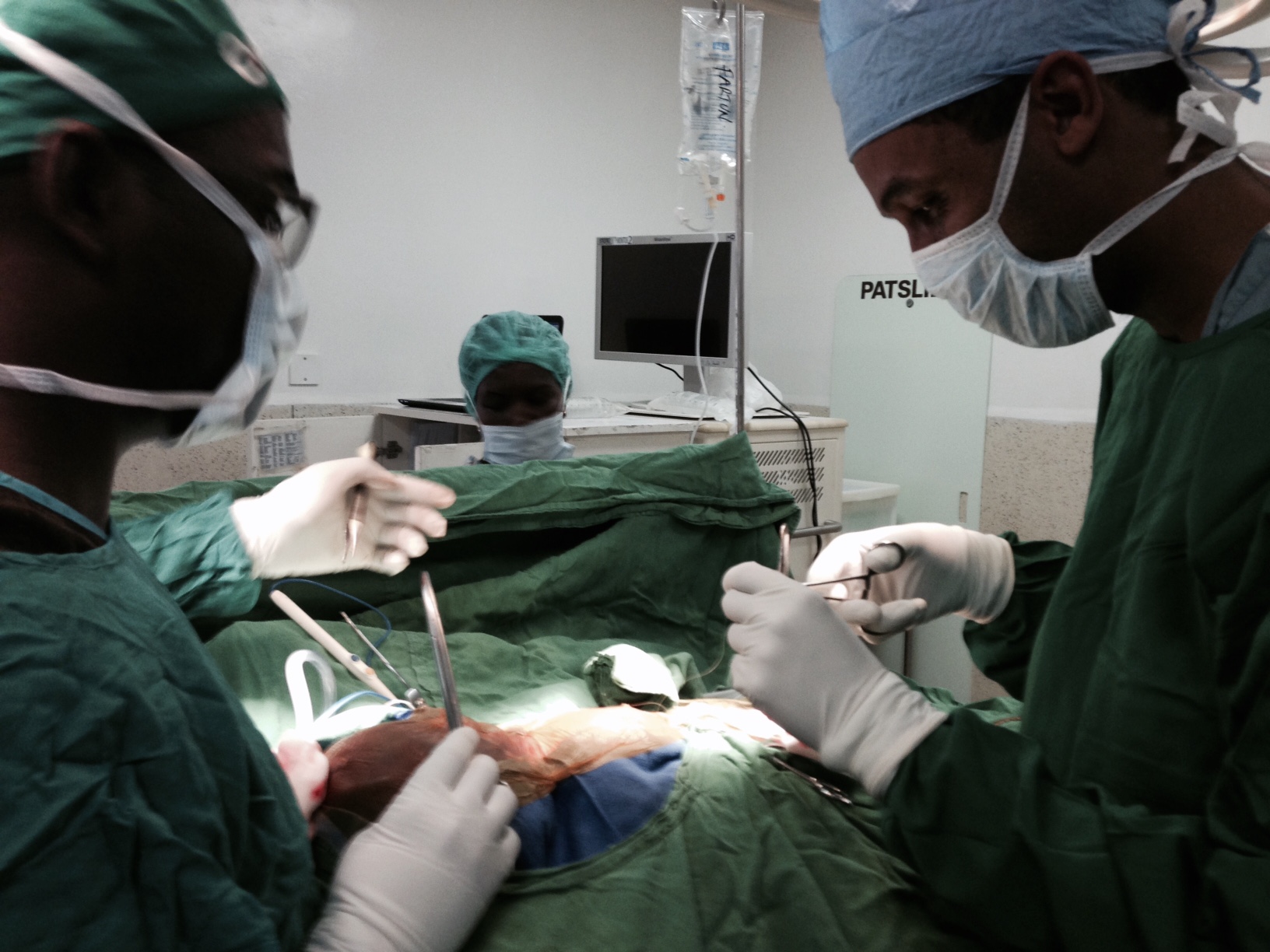
Kijabe OR

Even though I grew up in Kenya and made the drive often, there has always been something about the Great Rift Valley that inspires a sense of awe each time I see it. Perhaps, it is the sheer expanse of this structure that never ceases to inspire. Not too far beyond this impressive natural landscape, down a steep hill and a winding road whose potholes must be dodged with the lightning quick reflexes of a professional gamer lies AIC Kijabe Hospital. The last time I was in the town of Kijabe was for a camp as a teenager. At that time, a few friends and I imitated the classic 90’s R&B group Boys II Men. I was the bass that would randomly start speaking in the middle of the song saying things like “Girl, you know we belong together” But where were we? Ah, yes . . . Kijabe Hospital. I had just arrived for a month long rotation with the Pediatric Neurosurgery Department and could not wait . . .

I walked into the ward and was immediately struck by the fact that all the mothers and their children were in the same large room in contrast to the largely private rooms I had encountered in Pediatric Neurosurgery rotations in the States. My first thought was how difficult it must be to not have that privacy, but the longer I stayed in Kijabe I began to question that position. I think a moment that captured that reevaluation was when I walked into the ward one day and heard a mother singing to her child in full hearing of the room. What effect did that have on the other mothers? How much easier was it for these mothers to talk and support each other–without walls? Privacy makes a difference, of course, and a private room certainly brings certain conveniences but what do we sacrifice in community to obtain these conveniences? When does privacy become isolation?

Kijabe’s Pediatric Neurosurgery ward primarily consists of children with one or both of two common conditions here: hydrocephalus or spina bifida. Both of these conditions can have devastating neurological consequences if not appropriately treated so the work being done by the neurosurgeons in Kijabe is important and life altering. I had the privilege of scrubbing in on multiple surgeries including shunt placement, ETV (Endoscopic Third Ventriculostomy), Chiari decompression and myelomeningocele repairs. I was impressed by the technological capabilities of the operating rooms in Kijabe. Unfortunately, a fair number of patients present late, largely for financial reasons, when damage has already been done, highlighting the need for certain systemic changes.

In the process, I got to join an outstanding team. Our attending was Dr. Humphrey Okechi who has worked closely with Dr. Leland Albright of the University of Wisconsin, the Neurosurgeon who established the program in Kijabe. Also part of the team were an Ethiopian Fellow, Addis, (and by “Fellow” I am referring to his medical title, not a variation on “dude”!), a visiting senior resident from USC, Eisha, and a Kenyan resident, Peter, from the University of Nairobi. A wonderful senior nurse, chaplain, social worker and other dedicated workers, also supported us.

It is hard to capture the atmospherics of how welcoming it was in Kijabe but let me offer one example. Consider one simple gesture, the handshake. In America, you typically only shake someone’s hand the first time you meet him or her. But in working with this Kenya team, there would be handshakes all around every morning among the team. This simple point of contact provided acknowledgement and a sense of camaraderie that set the tone for the day.

Aside from the OR, my other responsibility was to conduct research on the cost effectiveness of Neurosurgical care in Kijabe. This led to many insightful conversations with mothers of affected children. Aside from expected costs, there were some challenging cultural scenarios they raised, such as being disowned in some cases by husbands whose relatives felt the distorted features of hydrocephalus were an indictment of the mother. It was difficult to hear of the financial struggles faced by many mothers in obtaining neurosurgical care for their children and how far many had to travel to Kijabe, one of only two places in the country to get dedicated pediatric neurosurgical care. But this information also emboldened me further to produce this research as part of an effort to ultimately enhance local capabilities in Neurosurgery.

The interesting and ultimately poignant contradiction in Kijabe was the juxtaposition between taxing neurosurgical cases and a certain lightness in how the staff faced their days. Of course, this lightness did not mean trivializing the high stakes of the patients’ conditions, but rather a refreshing ability to not carry this angst around. One moment, we were in the operating room performing a delicate decompression surgery and two hours later we’re on the soccer field (“football pitch” for any Kenyan readers!). We would play with talented local players and hospital staff many of whom spoke Kikuyu, so my Swahili did not help me with on the field strategizing. After managing to not be entirely useless on the field the first day, I did manage to translate one thing they said . . . “Pass the ball to Obama!”

Several seeds were sown on this trip. The first is the even stronger urge I have to contribute in Pediatric Neurosurgical care in Kijabe and beyond. The second is the need to disseminate the research that will help contribute to this effort. These two seeds will take time to grow. But the third seed can sprout today. It emerges from the ease with which I saw so many people in Kijabe able to experience the present moment despite challenges. And by that, I do not mean to suggest the patronizing sentiment that “those people just seemed so happy!” Many of the parents I spoke to did show signs of strain on their faces as they talked about their struggles taking care of sick children. But it was only in that moment, and their struggles were only part of their stories. Of course, faith was a key component as well; AIC Kijabe is a mission hospital. It all adds up to way of living that challenged me to bring some Kijabe back to the US. Giving people in your team handshakes everyday may seem a little weird here, but the idea behind it is surely worthwhile, the simple power of acknowledgment.

The Team, the team, the team . . .