Archive for the ‘Medical School’ Category

Improv 2

Improv! The word quickly connotes quick-witted actors leaping around a stage creating bizarre story lines. Or perhaps the word conjurs up Saturday Night Live or the classic Improv show, Whose Line is It Anyway? So, how did I find myself, in my fourth year of medical school, teaching Improv to MBA students?

Last year, I took part in a global social entrepreneurship student competition called the HULT prize. One my team members would later remember my background as a Theatre professor and actor and whispered that in the ear of the Design and Business Club at the University of Michigan Ross School of Business. They happen to have started a program of events known as StoryLab to expose business students to the nature of the story as a potential tool in business. They asked me if I would consider leading a workshop. As they had already learned about elements such as story structure, body language and physical presence, I thought the next step could be learning how to create a story from scratch, that is Improv!

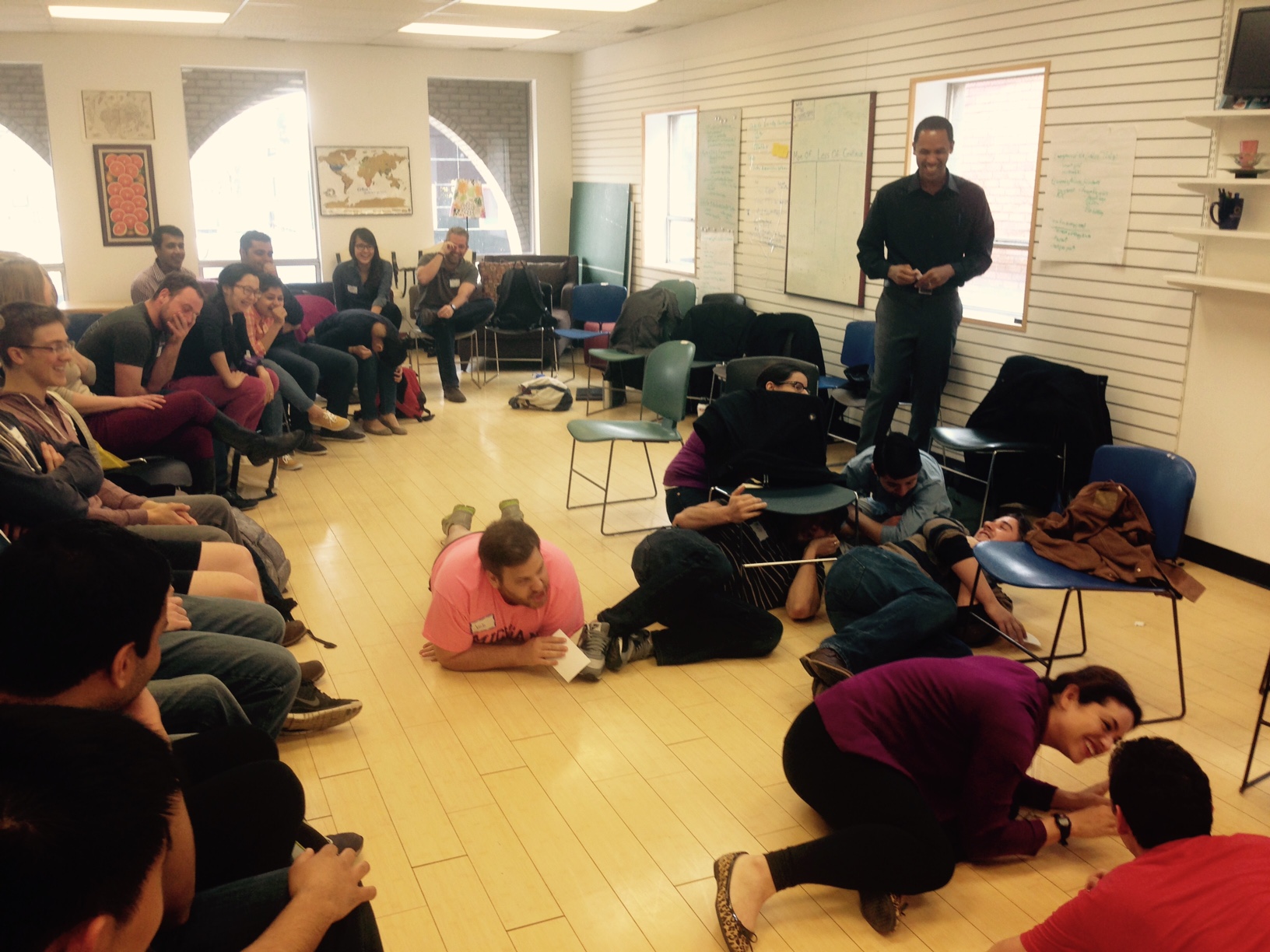
And so, on April 3rd, I met with a group of MBA students and we did Improv. I wanted this session to be fun, which Improv always is, but also relevant. I could have the students prance about the room like gazelles and that would be entertaining, but why would that ultimately matter to a group of business students? So the first thing I did was challenge the students to get beyond thinking of Improv as the purview of trained actors. I pointed them to the work of Theatre practitioner Keith Johnstone who notes that we are all born natural improvisers. Children create narratives effortlessly and transform everyday objects into dynamic magical things every day. As we speak, my son Cameron is making a cardboard box into full body armor and a helmet for space travel. Johnstone argues that this natural instinct is educated out many of us as we proceed through formal education. We are quickly reprogrammed to a world of stiff objectives, where conformity is the highest value. But our instinct, if we can rediscover it, is to playfully create. And this creativity is by no means trivial; it is needed to solve the most complicated problems that resist conventional thinking . . .

Improv 3

And so that is what we explored . . . what happens if you accept even the craziest sounding idea and run with it? How do you improvise around emotion? We improvised around silence. What is happening when no one is talking? We connected these explorations to real business situations such as an employee joining a new company or a brainstorming session.

At its most dynamic, Improv is about learning how to become agile with the unexpected. And that skill knows no boundaries of discipline: a business meeting takes an unexpected turn, a patient develops an unusual complication. For the first time, I saw three worlds intersecting instead of just the two that I most often write or think about, Theatre and Medicine. Theatre, Medicine and Business resonated off each other, and it made perfect sense.

One participant wrote to me after the session and asked if and how Improv plays into my daily life. I answered that Improv is a way of life. Life presents us with offers everyday from a conversation with a stranger at the grocery store to a life changing event such as a job loss or perhaps another disappointment or victory. At that moment, if you were on stage telling a fictionalized account, the story could not stop. You could not rail at the universe for things not having gone your way. You would have to embrace the change in direction, and embrace it fully then launch in the new direction, not knowing all the answers but asking the questions boldly. Or you could just say no, stay safe, unembarrassed, unhurt, unexposed . . . Improv challenges us to say “Yes” . . . that is my challenge everyday. I don’t always achieve it, but when I do . . . what a story!

Improv 1

Kijabe OR

Even though I grew up in Kenya and made the drive often, there has always been something about the Great Rift Valley that inspires a sense of awe each time I see it. Perhaps, it is the sheer expanse of this structure that never ceases to inspire. Not too far beyond this impressive natural landscape, down a steep hill and a winding road whose potholes must be dodged with the lightning quick reflexes of a professional gamer lies AIC Kijabe Hospital. The last time I was in the town of Kijabe was for a camp as a teenager. At that time, a few friends and I imitated the classic 90’s R&B group Boys II Men. I was the bass that would randomly start speaking in the middle of the song saying things like “Girl, you know we belong together” But where were we? Ah, yes . . . Kijabe Hospital. I had just arrived for a month long rotation with the Pediatric Neurosurgery Department and could not wait . . .

I walked into the ward and was immediately struck by the fact that all the mothers and their children were in the same large room in contrast to the largely private rooms I had encountered in Pediatric Neurosurgery rotations in the States. My first thought was how difficult it must be to not have that privacy, but the longer I stayed in Kijabe I began to question that position. I think a moment that captured that reevaluation was when I walked into the ward one day and heard a mother singing to her child in full hearing of the room. What effect did that have on the other mothers? How much easier was it for these mothers to talk and support each other–without walls? Privacy makes a difference, of course, and a private room certainly brings certain conveniences but what do we sacrifice in community to obtain these conveniences? When does privacy become isolation?

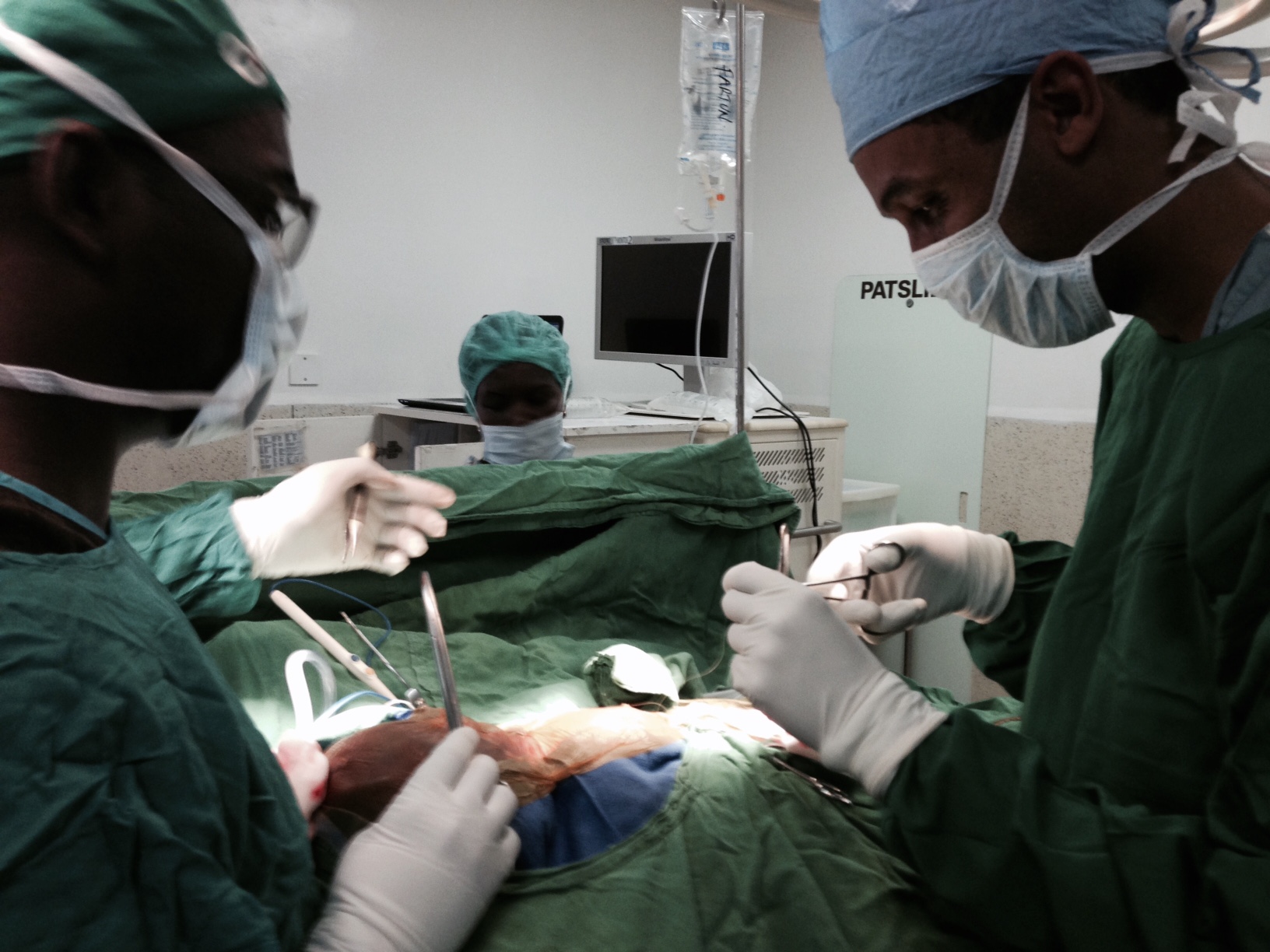
Kijabe’s Pediatric Neurosurgery ward primarily consists of children with one or both of two common conditions here: hydrocephalus or spina bifida. Both of these conditions can have devastating neurological consequences if not appropriately treated so the work being done by the neurosurgeons in Kijabe is important and life altering. I had the privilege of scrubbing in on multiple surgeries including shunt placement, ETV (Endoscopic Third Ventriculostomy), Chiari decompression and myelomeningocele repairs. I was impressed by the technological capabilities of the operating rooms in Kijabe. Unfortunately, a fair number of patients present late, largely for financial reasons, when damage has already been done, highlighting the need for certain systemic changes.

In the process, I got to join an outstanding team. Our attending was Dr. Humphrey Okechi who has worked closely with Dr. Leland Albright of the University of Wisconsin, the Neurosurgeon who established the program in Kijabe. Also part of the team were an Ethiopian Fellow, Addis, (and by “Fellow” I am referring to his medical title, not a variation on “dude”!), a visiting senior resident from USC, Eisha, and a Kenyan resident, Peter, from the University of Nairobi. A wonderful senior nurse, chaplain, social worker and other dedicated workers, also supported us.

It is hard to capture the atmospherics of how welcoming it was in Kijabe but let me offer one example. Consider one simple gesture, the handshake. In America, you typically only shake someone’s hand the first time you meet him or her. But in working with this Kenya team, there would be handshakes all around every morning among the team. This simple point of contact provided acknowledgement and a sense of camaraderie that set the tone for the day.

Aside from the OR, my other responsibility was to conduct research on the cost effectiveness of Neurosurgical care in Kijabe. This led to many insightful conversations with mothers of affected children. Aside from expected costs, there were some challenging cultural scenarios they raised, such as being disowned in some cases by husbands whose relatives felt the distorted features of hydrocephalus were an indictment of the mother. It was difficult to hear of the financial struggles faced by many mothers in obtaining neurosurgical care for their children and how far many had to travel to Kijabe, one of only two places in the country to get dedicated pediatric neurosurgical care. But this information also emboldened me further to produce this research as part of an effort to ultimately enhance local capabilities in Neurosurgery.

The interesting and ultimately poignant contradiction in Kijabe was the juxtaposition between taxing neurosurgical cases and a certain lightness in how the staff faced their days. Of course, this lightness did not mean trivializing the high stakes of the patients’ conditions, but rather a refreshing ability to not carry this angst around. One moment, we were in the operating room performing a delicate decompression surgery and two hours later we’re on the soccer field (“football pitch” for any Kenyan readers!). We would play with talented local players and hospital staff many of whom spoke Kikuyu, so my Swahili did not help me with on the field strategizing. After managing to not be entirely useless on the field the first day, I did manage to translate one thing they said . . . “Pass the ball to Obama!”

Several seeds were sown on this trip. The first is the even stronger urge I have to contribute in Pediatric Neurosurgical care in Kijabe and beyond. The second is the need to disseminate the research that will help contribute to this effort. These two seeds will take time to grow. But the third seed can sprout today. It emerges from the ease with which I saw so many people in Kijabe able to experience the present moment despite challenges. And by that, I do not mean to suggest the patronizing sentiment that “those people just seemed so happy!” Many of the parents I spoke to did show signs of strain on their faces as they talked about their struggles taking care of sick children. But it was only in that moment, and their struggles were only part of their stories. Of course, faith was a key component as well; AIC Kijabe is a mission hospital. It all adds up to way of living that challenged me to bring some Kijabe back to the US. Giving people in your team handshakes everyday may seem a little weird here, but the idea behind it is surely worthwhile, the simple power of acknowledgment.

The Team, the team, the team . . .